3 Raccoons in a Trenchcoat
3 Raccoons in a Trenchcoat
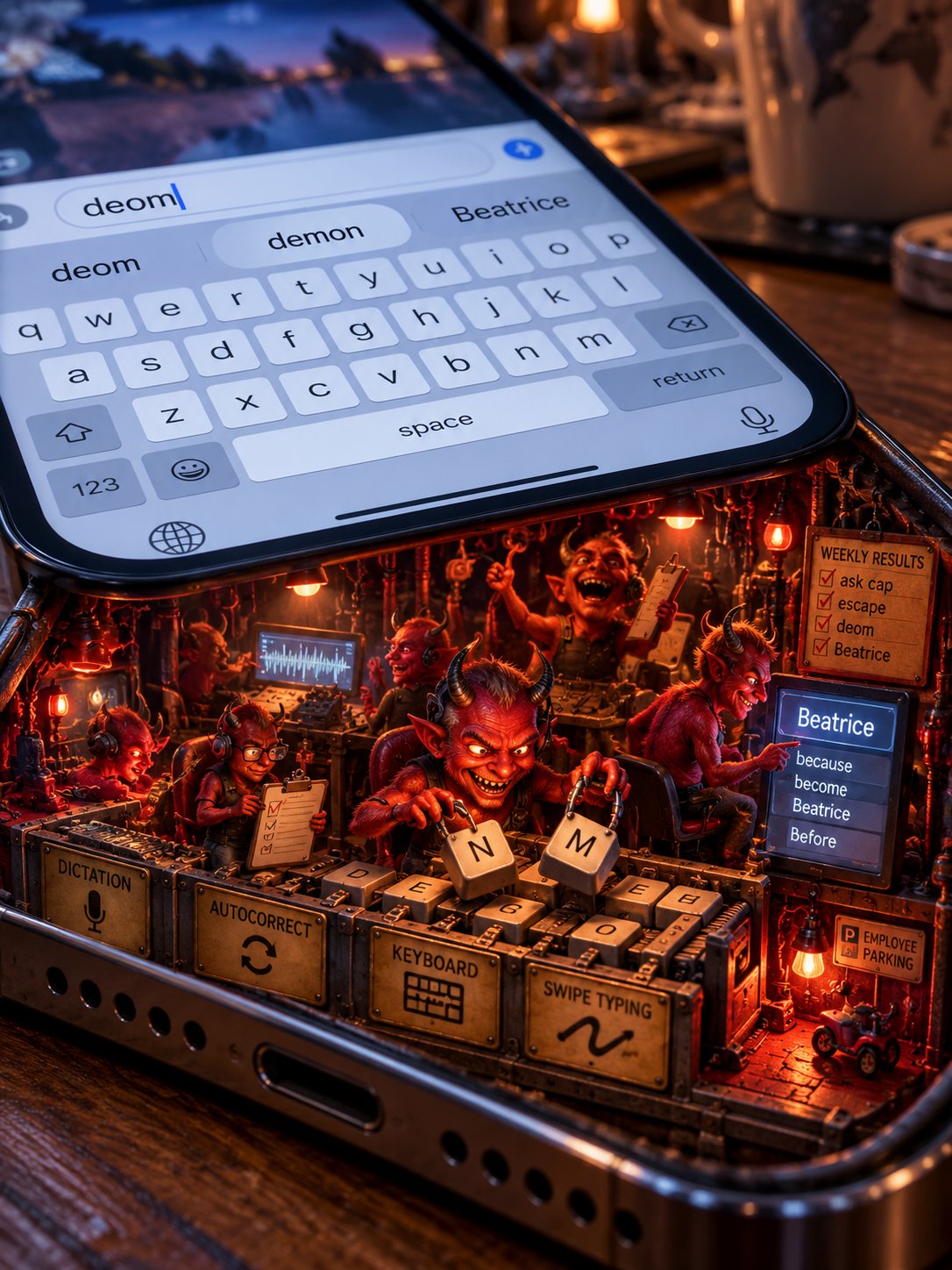
I have reached the conclusion that my phone is inhabited by tiny demons.
I did not arrive at this conclusion casually. I am a rational adult who understands that modern smartphones are enormously complicated devices containing processors, neural networks, predictive text systems and other sophisticated technologies whose purpose, according to the manufacturers, is to make our lives easier. I therefore spent many years assuming there must be some legitimate technological explanation for why I can say, type or swipe a perfectly ordinary English word into my phone and get back something that appears to have been dictated by a raccoon falling down a staircase.
There is not.
It is demons.
The evidence became conclusive recently when I was discussing this exact theory and attempted to type the phrase “demon keyboard.”
My phone produced “deom keyboard.”
I want to emphasize that I did not dictate the word “demon.” I did not swipe it using some vague finger gesture that could reasonably be interpreted as an alternate word. I typed it.
D. E. M. O. N.
The keyboard, while being accused of harboring said demons, altered the word “demon.”
This is approximately what would happen if you walked into a police station to report that the evidence room was being burglarized and, while you were speaking, somebody quietly stole the evidence room.
At that point the investigation changed considerably.
Until then, I had believed the problem was primarily voice-to-text, which is supposedly a system whereby the phone listens to what you say and then converts those sounds into written language. This description is technically correct in the same sense that a slot machine is a device whereby you insert money and potentially receive money. There are several intermediate steps, and most of them appear designed to hurt you.
Voice-to-text works beautifully when I say things I do not particularly care about. I could presumably dictate, “The beige municipal building contains seven filing cabinets,” and receive a flawless transcription suitable for publication in an architectural journal. But the moment I say the name of a piece of music software, a band, a song, an acronym or anything else relevant to my actual life, the phone becomes a nineteenth-century spiritualist attempting to channel a dead Latvian farmer.
ASCAP is a particular problem.
ASCAP is not an obscure collection of throat noises from an extinct civilization. It is a major American performing-rights organization that has existed for more than a century. Nevertheless, every time I say “ASCAP” to my phone, the phone behaves as though this is the first time those sounds have occurred anywhere in the known universe.
I say, “ASCAP.”
The phone considers this.
Then it gives me “ask cap.”
This is not merely wrong. This creates an entirely new concept. Somewhere there is apparently a cap whose function is to answer questions.
I try again.
“ASCAP.”
“Escape.”
No.
“A. S. C. A. P.”
At this point dictation sometimes simply stops, which I interpret as the machine equivalent of putting its fingers in its ears.
Typing should solve this problem, except that phone keyboards were clearly designed during a period when the average human thumb was believed to be approximately the diameter of a drinking straw. My desktop keyboard operates according to the traditional arrangement under which pressing the letter K results in the letter K. This system has served humanity reliably for generations. My phone regards it as hopelessly old-fashioned.
A smartphone keyboard has apparently been designed around the more dynamic philosophy that when I press K, several letters in the surrounding area should also be allowed to submit competing bids.
This would explain why I sometimes look down after typing a sentence and discover that my fingers have produced something I have absolutely no memory of entering. At first I blamed the phone. I am now forced to confront a more disturbing possibility, namely that the demons have escaped the device and are operating my hands directly.
I do not know exactly how this works anatomically. I assume there are extremely small imps stationed in the joints of my thumbs. They probably have little control rooms.
“Target approaching the N.”
“Copy.”
“Redirecting to M.”
“Excellent. She’s typing ‘demon.’”
“Should we interfere?”
“Obviously.”
And that is how we got “deom.”
Then there is swipe typing, which in theory should solve both the tiny-keyboard problem and the dictation problem. With swipe typing, you simply move your finger across the letters of the word you want, and the phone uses advanced artificial intelligence to determine what you meant.
This is where Beatrice comes in.
I want to be clear that there is no Beatrice.
I do not know anyone named Beatrice. I am not attempting to contact a Beatrice. Beatrice has no legitimate business appearing in my correspondence.
Nevertheless, swipe typing periodically produces words with the confidence of a system that has uncovered important new witnesses.
I swipe something completely normal, such as “because.”
The phone says, in effect, “You mean Beatrice.”
No, phone.
I do not mean Beatrice.
I have never meant Beatrice.
If at any point in my life I need to type the word Beatrice, I promise to notify you personally.
Autocorrect, meanwhile, was ostensibly created to prevent these problems, but somewhere along the way it became radicalized.
Autocorrect no longer seems interested in whether a word is actually wrong. It waits until I have successfully typed what I intended, then substitutes something else after I move on, presumably because it feels the sentence could benefit from a surprise guest.
This means that using my phone now involves a complex editing process in which I type a sentence, reread it, repair the damage, continue typing, then return to discover that autocorrect has quietly restored the damage while I was away.
This is not proofreading.
This is Whac-A-Mole with vocabulary.
The demons appear to be extremely well organized. I picture them divided into departments. Dictation handles large-scale semantic sabotage. Autocorrect specializes in retroactive alteration. The touchscreen division interferes directly with finger placement. Swipe typing operates an experimental program whose purpose appears to be inserting Beatrice into as many conversations as possible.
There is probably a management structure.
Every Monday morning they gather for a staff meeting somewhere behind the battery.
“All right, everyone, excellent numbers last week. Dictation, you turned ‘synth’ into ‘sink’ three times. Strong performance.”
“Thank you.”
“Autocorrect, you changed a correctly typed technical term after the user had already proofread it.”
“We’re very proud of that.”
“And who altered ‘demon’ during the conversation about demons?”
A tiny hand goes up.
The room erupts in applause.
“Outstanding work, Jenkins. You’re getting a parking space.”
The truly humiliating part is that I continue using all of these systems because the alternatives are somehow worse.
I could type every message manually on the microscopic keyboard, but eventually I would require surgical replacement thumbs.
I could use swipe typing, but then Beatrice would become involved.
So I return to voice-to-text.
Every single time.
I press the microphone button and begin speaking with the cautious optimism of someone who has repeatedly purchased food from a vending machine that previously trapped their sandwich.
And to be fair, the system usually gets most of the words right. This is actually what makes the errors so effective. The phone does not produce total gibberish, because I would simply stop using it. Instead, it waits until I am forty words into a perfectly coherent paragraph and replaces one crucial noun with something so bizarre that the entire message changes genre.
Fortunately, Google has now encountered enough of these messages that another layer of technology has evolved around the problem.
I speak English.
The phone converts the English into whatever language the demons use.
Google examines the resulting wreckage and says, essentially, “I believe you meant ‘ASCAP.’”
So we have now developed a technological system in which one artificial intelligence mangles my sentence and another artificial intelligence reconstructs it.
This is progress.
Human civilization spent thousands of years developing written language, movable type, telecommunications, computers and the global internet so that I could eventually send the sentence I originally intended after it passes through two separate machines and possibly Beatrice.
The only thing I do not understand is what the demons ultimately want.
Maybe they feed on frustration. Maybe each incorrect word generates a tiny electrical charge that sustains them. Maybe they are conducting a long-term experiment designed to determine how many times one person can say, “THAT IS NOT WHAT I FUCKING SAID,” before throwing a thousand-dollar electronic device into the sun.
Whatever the goal, they have made one strategic mistake.
They revealed themselves.
Because I typed “demon.”
And they changed it.
Which means I now know exactly where they live.
Unfortunately, I will have to continue communicating with them by phone.
My tgumbs hurt.
Say Something
No account needed. Just a name and, if you want, a link to your own work.