3 Raccoons in a Trenchcoat
3 Raccoons in a Trenchcoat
Dear Refrigerator,
I am writing because our relationship has reached a point where formal documentation is now necessary. You will not close your door. This is, to put it mildly, a problem, because you are a refrigerator. Closing your door is not an optional feature, a stretch goal, or something that should appear on an annual performance review under “areas for improvement.” It is the central organizing principle of your existence. You make things cold, and the way you accomplish this is by keeping the cold inside you instead of quietly leaking it into the kitchen like a badly managed Arctic research station.
For quite some time, I attempted to give you the benefit of the doubt. I assumed perhaps I had not pushed hard enough, or that some innocent jar of mustard was interfering with the seal, or that one of the drawers was slightly out of position. I rearranged shelves, moved containers backward, checked for obstructions, and approached the situation with the sort of patience and optimism normally reserved for people who believe a printer will start working because they clicked “Print” a second time. None of this helped. Instead, you continued your little routine in which I close the door, you appear to close, and then at some point after I walk away you quietly relax by approximately half an inch, not enough to make a dramatic statement, but just enough to let the cold out, the warm air in, and the milk begin considering its legal options.
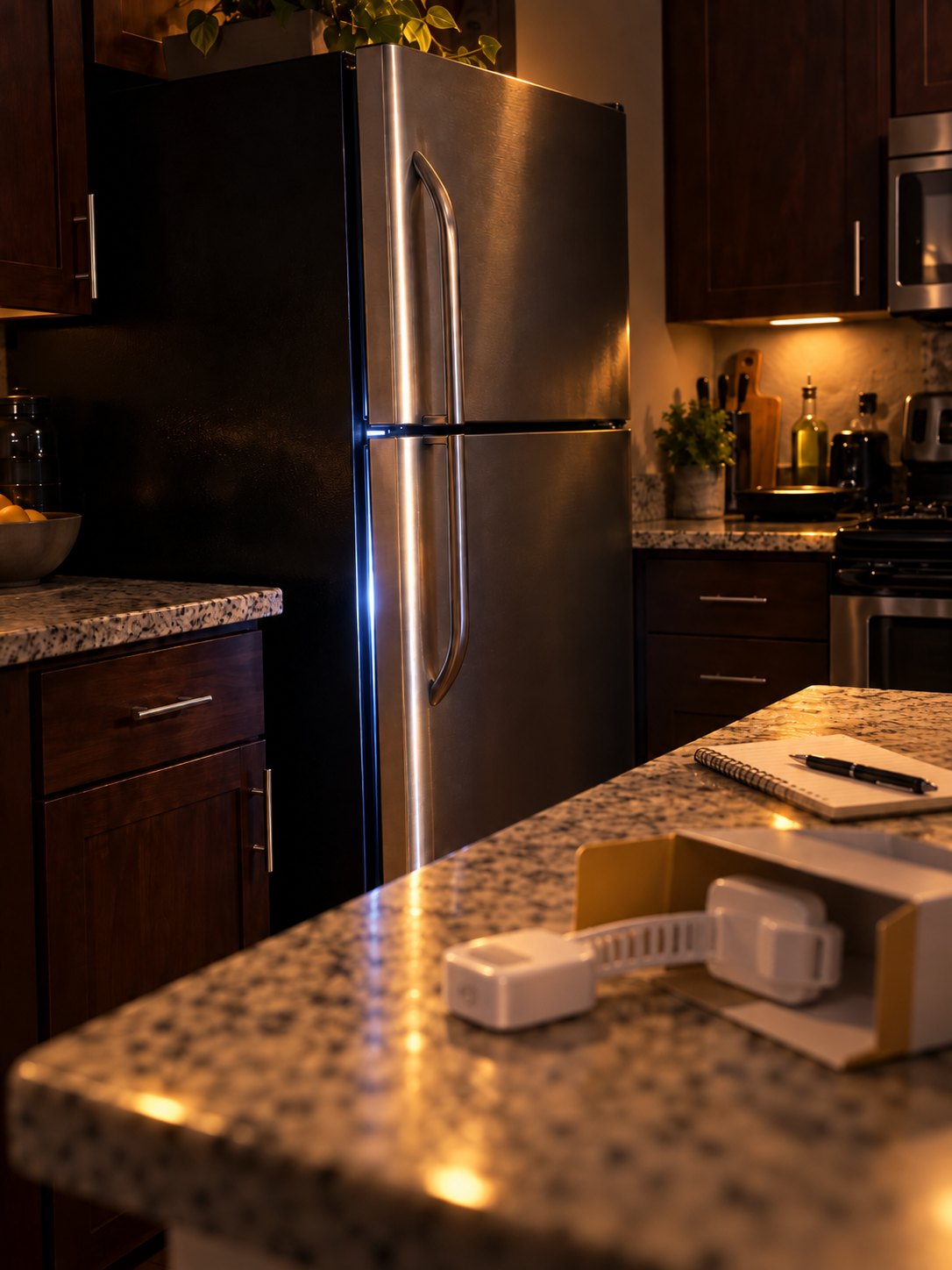
This behavior has now forced me to install a child lock, and I would like you to take a moment to consider the humiliation inherent in that. You are a full-sized household appliance built by adults with engineering degrees, and I now have to restrain you with the same category of device used to prevent toddlers from opening cabinets and drinking floor cleaner. I did not want this for you, and I certainly did not want it for me. I did not want every trip for a drink to involve a small containment procedure, nor did I expect that one day I would be standing in my own kitchen fastening a safety latch onto a refrigerator whose entire job could already be summarized as “remain closed.” Yet here we are, and every time the lock clicks into place it carries the solemn dignity of a prison gate being shut on someone who has repeatedly demonstrated that they cannot be trusted with freedom.
This has damaged trust between us. There was once a time when I could close your door and simply walk away, secure in the knowledge that the transaction was complete. I remember those days fondly. Now I close you, give you a suspicious extra push, engage the lock, stare at the seal for a few seconds, walk away, and then occasionally find myself looking back because apparently I now live with an appliance that requires supervision. I should not have to babysit mayonnaise. I should not have to wonder whether the cheese is safe because you decided to spend the afternoon hovering in a state best described as “technically not open enough to look alarming, but definitely not closed enough to do your job.” That is not a charming quirk. That is passive-aggressive refrigeration.
There is also the matter of electricity, because when you sit there half-open, heroically attempting to refrigerate the entire kitchen, someone has to pay for that effort, and that someone is not you. You contribute nothing financially to this household. You do not pay rent, buy groceries, replace spoiled food, or even purchase your own light bulb. The absolute minimum I expect in return is that you refrain from running the compressor for six straight hours because you have decided the kitchen should be brought down to deli-counter temperature. If you feel strongly that the entire room ought to be kept at 38 degrees, I suggest you take the matter up with the HVAC system, which will ignore you because it understands professional boundaries.
And before you attempt to claim that you are technically closed, let me stop you there. You are not. I know what closed looks like. I can see the light when you are not. I can feel the cold air escaping. This is not some philosophical gray area in which “shut” is open to interpretation, nor is this quantum refrigeration where the door exists in both states until observed. The door is either closed or it is not, and if I can stand in the kitchen wondering whether the yogurt has just spent three hours enjoying room temperature, then we already have our answer.
I want you to understand that the child lock is not revenge. It is not punishment. It is what happens when an appliance loses door privileges. I would genuinely like to return to a simpler relationship in which I put food inside you, you keep it cold, and neither of us has to think very much about the other. That is the dream. Until such time as you demonstrate a sustained commitment to basic door-related competence, however, the lock stays.
You did this to yourself.
Sincerely,
The Person Who Should Not Need to Put a Child Lock on a Refrigerator
Say Something
No account needed. Just a name and, if you want, a link to your own work.